Building wealth on a ₹1 lakh monthly investment needs a disciplined and structured approach. Higher Net Worth Individuals (HNIs) increasingly depend on SIP to create long term wealth via mutual funds. Mutual funds offer professionally managed portfolios, diversification across bonds and equities. So with consistent SIP contribution investors can reduce market timing risks and benefit from compounding. This write up explains a practical HNI SIP strategy and a ₹1 lakh per month mutual fund portfolio for 2026 designed to balance growth, stability and long term financial goals properly and efficiently for investors today.
Need Help? Request a Free Call from an Expert
Let our Experts guide you through your Investment journey. From Monthly SIP in any Fund to your Financial Planning.

₹1 Lakh SIP Growth Projections: Corpus in 10, 20 & 30 Years
Now let us explore what investment of ₹1 lakh per month compounds across different time horizons at moderate return assumptions. These figures are calculated at a 14-15% CAGR, which is a reasonable long term expectation for a well diversified equity heavy mutual fund portfolio.
| Horizon | Monthly SIP | Total Invested | Gains | Projected Corpus (14–15% CAGR) |
|---|---|---|---|---|
| 10 Years | ₹1,00,000 | ₹1.20 Cr | ₹1.55 Cr | ₹2.75 Cr |
| 20 Years | ₹1,00,000 | ₹2.40 Cr | ₹12.57 Cr | ₹14.97 Cr |
| 30 Years | ₹1,00,000 | ₹3.60 Cr | ₹65.63 Cr | ₹69.23 Cr |
Pro tips: With SIP return calculator investors can check their returns in future.
Pro Tips: A CAGR Calculator helps you find out how much your investment has grown each year.
Ideal Asset Allocation for a ₹1 Lakh HNI Mutual Fund SIP Portfolio
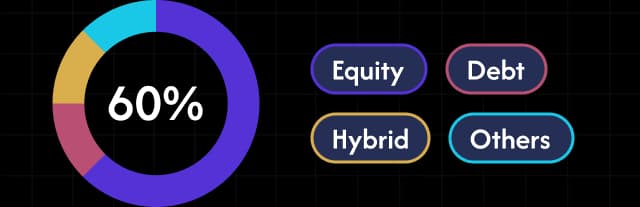
A ₹1 lakh HNI mutual fund portfolio needs a balanced asset allocation strategy that diversifies across debt, equity and alternatives to optimize risk adjusted long term returns:
For an HNI investor with a more than 10 year horizon, a predominantly equity heavy allocation is recommended. Below is the suggested model allocation for a 35-45 year old HNI with moderate to high risk appetite:
| Asset Class | Monthly Allocation | % of Portfolio | Role in Portfolio |
|---|---|---|---|
| Large Cap / Value | ₹25,000 | 25% | Core stability, low-cost market returns |
| Mid Cap Funds | ₹15,000 | 15% | Higher growth, moderate volatility |
| Small Cap Funds | ₹10,000 | 10% | High-growth satellite allocation |
| Flexi-Cap / Multi-Cap | ₹20,000 | 20% | Dynamic allocation across market caps |
| International / Global Funds | ₹15,000 | 15% | Geographic diversification, USD exposure |
| Debt / Hybrid Funds | ₹10,000 | 10% | Capital preservation, rebalancing buffer |
| Gold MF / Silver MF | ₹5,000 | 5% | Inflation hedge, portfolio insurance |
| Total | ₹1,00,000 | 100% | — |
The categorization of asset classes is as follows:
- Equity: Large Cap/Value, Mid Cap Funds, Small Cap Funds, Flexi-Cap / Multi-Cap, International / Global Funds.
- Debt: Debt / Hybrid Funds
- Commodities: Gold mutual fundsor Silver mutual funds
Best Mutual Fund Categories for Your ₹1 Lakh SIP
A ₹1 lakh SIP can be strategically allocated across diverse mutual fund categories including equity, debt, and hybrid, to balance growth and long term wealth creation efficiently:
Index Fund & Large Cap Funds: Core Allocation
Sensex index and Nifty 50 index funds are the backbone of any HNI mutual fund portfolio. Because of a low expense ratio of 0.05-0.10%, these funds deliver pure market returns without the manager selection risk. Keeping at least 25% in passive large cap exposure ensures low cost, tax efficiency and consistent compounding.
Flexi Cap & Multi Cap Funds: Dynamic Exposure
Flexi cap funds provide fund managers the freedom to move capital across large, mid and small cap segments on the basis of valuations and market conditions.These are ideal for those who want active management without committing to a specific market cap section Multi-cap funds mandated by SEBI to hold 25% each in large, mid, and small caps offer built-in diversification.
Mid Cap & Small Cap Funds: Growth Engine
For long term wealth creation, mid an small cap fund have historically delivered superior returns, but with significantly higher volatility. So an HNI with a 15+ year horizon can comfortably allocate 20-25% here. Though these funds underperform for 2 to 3 years before delivering sharp re rating gains.
Technology & IT Sector Funds: Thematic Satellite
IT sector mutual funds provide concentrated exposure to India's digital economy including IT services, software products and emerging tech companies. So a 5-8% allocation as a satellite position can enhance long term returns for HNIs.
International Funds: Currency Diversification
International funds including US equities, global tech or developed market indices offer important geographic diversification and an implicit USD hedge for Indian investors. For ₹1 lakh per month, a 10-15k monthly SIP into a US index or global fund is a prudent hedge against INR depreciation.
ELSS Funds: Tax Efficient Allocation
Equity linked savings schemes qualify for deduction under Section 80C. HNIs can route ₹12,500 per month into ELSS funds, which combine tax savings with equity exposure. ELSS carries a 3 year lock in the shortest among 80C instruments.


Smart Investments, Bigger Returns

Maximize SIP Returns: Smart Fund Selection & Cost Optimization for HNIs
HNI can maximize SIP returns by opting high quality funds, maintaining diversification and long term investment strategies:
Cost Awareness
Cost awareness is one of the most direct levers of long term wealth creation. A difference of 0.5% in total expense ratio on a ₹1 lakh per month SIP translates to ₹50,000 in additional annual charges. So evaluating the total cost of funds, like expense ratios and exit loads is a necessary step in building any serious portfolio.
Understanding Expense Ratios Across Fund Categories
Expense ratios vary significantly across the fund types. Index and passive funds usually charge 0.05 to 0.20% yearly. Actively managed large cap and flexi cap funds usually range from 0.5 to 1.2 %, whereas mid-cap and small cap actively managed funds may go up to 1.5 to 1.8%. So comparing the expense ratios within the same category not across various categories.
Limit Active Fund Overlap
A common mistake among HNI investors is holding too many active funds that invest in the same large cap stocks. This creates duplicates instead of genuine diversification. Conducting periodic portfolio overlap analysis ensures that every fund in the portfolio serves a different purpose.
Stick to 5–7 Well-Selected Funds
Research shows that diversification benefits reduce significantly beyond 5-7 well selected funds. A simple portfolio comprising an index fund, flexi-cap fund, mid cap fund, small cap fund and international fund is usually sufficient to achieve broad diversification without unnecessary complexity.
Step-Up SIP Strategy for High-Income Investors: Beyond ₹1 Lakh Per Month
A step up SIP or sometimes referred to as top up SIP, automatically increases your monthly SIP amount every year by a fixed percentage or amount. It helps your investments grow alongside your income, and making wealth creation faster and more proficient. If investors want to calculate their exact return over the years, then the step-up SIP calculator can be useful for future projection.
| Year | Monthly SIP (10% Step-Up) | Annual Investment | Cumulative Invested | Projected Corpus (12% CAGR) |
|---|---|---|---|---|
| Year 1 | ₹1,00,000 | ₹12.0 L | ₹12.0 L | ₹12.7 L |
| Year 3 | ₹1,21,000 | ₹14.5 L | ₹40.9 L | ₹50.3 L |
| Year 5 | ₹1,46,410 | ₹17.6 L | ₹73.3 L | ₹1.04 Cr |
| Year 10 | ₹2,35,795 | ₹28.3 L | ₹1.91 Cr | ₹3.87 Cr |
| Year 20 | ₹6,11,591 | ₹73.4 L | ₹6.73 Cr | ₹24.6 Cr |
Tax Planning for HNI SIP Investors: LTCG, STCG & ELSS Savings in 2026
For HNI investing ₹1 lakh per month, tax efficiency can add lakhs, sometimes crores. Thus understanding the mutual fund taxation rules is just as vital as choosing the appropriate investments.
| Fund Type | Holding Period | Latest Tax Rate (FY 2025-26) | Key Notes |
|---|---|---|---|
| Equity Funds (LTCG) | More than 12 months | 12.5% above ₹1.25L gains | ₹1.25 lakh annual LTCG exempt |
| Equity Funds (STCG) | Up to 12 months | 20% | Higher tax on short-term redemptions |
| Debt Funds | Any period | Taxed as per the slab rate | No indexation & no LTCG benefit |
| ELSS Funds | 3-year lock-in | 12.5% LTCG above ₹1.25L | Eligible for ₹1.5L deduction under Section 80C (Old Regime) |
| International Funds / Global FoFs | Up to 24 months: Slab Rate • More than 24 months: 12.5% LTCG (without indexation) | Tax treatment depends on purchase date & structure | Most are treated as non-equity funds |
How to Monitor & Track Your ₹1 Lakh HNI SIP ?
Investing ₹1 lakh per month is the only starting point, however, the long term success depends on disciplined monitoring and periodic rebalancing and staying invested through market volatility.
Review Annual Portfolio Checklist
Every 12 months, review your portfolio against the following criteria not more frequently because over monitoring leads to overthinking, can take help from the SIP return calculator for this task.
| # | What to Check | Trigger Condition | Action |
|---|---|---|---|
| 1 | Asset allocation drift | Equity share > 80% or < 65% | Rebalance by redirecting new SIPs toward underweight asset classes - avoid selling existing holdings |
| 2 | Fund underperformance | 3-year rolling returns 3%+ below benchmark | If style/cycle issue, hold. If persistent manager underperformance, switch to an index alternative |
| 3 | Expense ratio creep | Any large-cap or flexi-cap fund > 1.2% TER | Switch to a lower-cost fund in the same category - compare options across platforms |
| 4 | Life goal change | Marriage, childbirth, job change, approaching retirement | Re-assess target corpus, time horizon, and SIP amount using a SIP Return Calculator |
| 5 | Tax harvesting window | February–March annually | Book up to ₹1.25 lakh in equity LTCG gains tax-free; immediately reinvest to reset cost basis |
Behavioural Discipline: The Real Alpha
Studies reflect that investors underperform the fund by an average of 3 to 5% yearly because of emotional decisions like panic selling or chasing returns. Staying invested via market cycles matters more than ever timing or switching funds.
Conclusion
To conclude a ₹1 lakh per month SIP can potentially build a ₹10–25 crore corpus over 20 to 25 years if executed properly. As success largely depends on timing and stock picking and more on asset allocation, cost control and disciplined step ups and tax efficiency. Thus keep a simple 5-7 mutual funds portfolio across equity, global and debt. One should use direct plans only and increase SIP by 10% annually, rebalance yearly and stay invested via cycles. Wealth is created not by predicting markets but by consistency, discipline and letting compounding work over time.
Also Read -
https://blog.mysiponline.com/how-to-plan-your-sip-in-india
https://blog.mysiponline.com/it-sector-mutual-fund-sip
FAQs
Can I Invest ₹1 lakh Per Month In SIP For My Child's Future Education Fund?
Yes you can invest ₹1 lakh on monthly basis in SIP for your child’s education. It builds disciplined wealth creation, beats inflation and supports long term goal oriented financial planning properly strategy planning.
What is the Role of International Funds In an HNI SIP Portfolio?
International funds offers HNI SIP portfolios with:
- Global diversification
- Currency hedge benefits
- Reduced domestic risk
- Exposure to high-growth companies
How Does MySIPonline Help HNI Investors Manage a Complex ₹1 lakh Monthly SIP Portfolio?
MYSIPonline assists HNI investors in managing a ₹1 lakh SIP portfolio desertification, automated investments and simplified reporting across multiple mutual fund schemes properly system support.