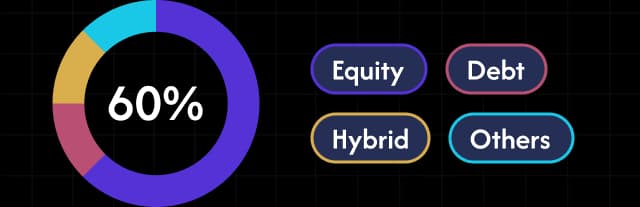
A Fund of Funds (FoF) is an investment option that does not invest directly in stocks or bonds. Apart from this it invests in a group of different mutual fund that gives you diversified exposure in a single product. This makes investing simpler because it provides diversified exposure in a single product. This makes investing simpler because one FoF can spread your money across multiple fund managers and asset classes.
Prior, FoF were mainly used by large institutions but now they are easily available to regular investors as well. However all FoFs are not the same. Thus a good FoF can help grow your wealth over time whereas a poor one may reduce your returns because of higher fees. The guide below explains the definition of FoFs, types, best options and how to opt for the right one.
What Is a Fund of Funds?
The Fund of Funds (FoF) refers to the mutual fund scheme which invests in other mutual fund schemes instead of directly investing in stocks or bonds. This may invest in funds from the same or varied fund houses. FoFs help investors diversify by spreading money across the various funds that can reduce risk.
Most of the FoF act like feeder funds by investing primarily in one underlying fund. They can invest in domestic or international funds, which largely depend on the objective of the scheme and asset allocation, offering broader diversification.
Structure of a Fund of Funds
Knowing the structure of an FoF helps explain both its benefits and its limitations:
- The parent fund (FoF scheme) is the scheme you actually invest in. This is managed by an AMC and with its own fund manager, NAV and expense ratio.
- The underlying Funds the parent fund’s manager allocates the pooled money across a set of underlying mutual fund schemes.
- The underlying assets in return hold their own portfolio of stocks, bonds, gold or other securities. So your money passes through two layers before it reaches the actual market.
- Two layers of costs as there are two fund management layers. FoF usually carry two sets of expenses including the FoF own expense ratio and a share of the underlying fund’s expense ratios. This is a vital factor to weigh before investing that we cover later in this guide.
This layered structure is what allows an FoF to give you instant diversification across fund managers, strategies and sometimes even geographies, all from a single SIP or lumpsum investment.
Types of Fund of Funds
Not all FoFs work the same way. Depending on what they invest in, FoFs in India are broadly classified into the following types:
1.Domestic Fund of Funds
These FoFs invest completely in Indian mutual fund schemes, which are a blend of equity, debt or hybrid managed by domestic AMCs. These funds are ideal for investors who are looking for diversification within the Indian market without picking individual schemes themselves.
2.International Fund of Funds
These FoFs invest in mutual funds that are based in foreign markets offering Indian investors exposure to global equities including US technology companies, European industrial or other global indices without the hassle of opening an overseas trading account.
3.ETF Based Fund of Funds
Instead of investing in actively managed mutual funds these FoFs invest in a basket of ETFs. They suit investors who prefer a passive, lower cost investing style while still wanting the convenience of a single mutual fund structure.
4.Asset Allocation/ Multi Asset Fund of Funds
These FoFs split investments across asset classes depending on the market conditions. The fund manager adjusts the allocation on your behalf that can help smooth returns across market cycles.
5.Gold & Commodity Fund of Funds
A particular type of FoF which invests in gold ETFs or commodity linked schemes. This allows investors to gain commodity exposure via a regular mutual fund folio instead of holding physical gold or a demat account.
6.Fixed Maturity
Some of FoFs specially retirements or children’s goal oriented funds follow a glide path. It starts with higher equity exposure and gradually shifts to debt as the target date approaches. Each type serves a different objective thus the right choices depend entirely on your financial goal, time horizon and risk appetite.
7.Sector Specific Fund of Funds
These funds concentrate on a specific sector including defence, energy or electric vehicles, etc. It invests in funds with a particular focus on a particular sector, like passive fund FoF, global technology FoF, retirement FoF. Before choosing any of the funds, it is vital to consider the investment objectives, investment strategy, financial goals and risk return profile
Pro tips: A systematic investment plan calculator or SIP Calculator is the best tool to calculate how much returns you can earn from your SIP.
Key Advantages of Fund of Funds
The FoF provides global exposure, professional management, diversification along with convenience in a single investment:
1.Built-in Diversification
FoFs invest in numerous mutual funds across various asset classes including equity, debt and gold. It spreads risk, thus if one fund underperforms, others can balance it and help to stabilise returns.
2.Easy Global Exposure
FoF make global investing simple. With one investment, you can access global markets like the US, Europe or Asia without handling foreign accounts, taxes or currency issues. Experts manage everything for you.
3.Professional Management
FoF are managed by experienced fund managers who choose the best underlying funds. Each selected fund also has its own expert manager, giving layers of professional oversight and better decision making.
Important Factors to Consider Before Choosing a FoF
Investing in a Fund of Funds can be an attractive way to gain diversified exposure across different underlying funds. So before committing capital investors weigh several critical dimensions that can significantly impact returns and risk:
1.Investment Strategy & Alignment
Understanding the overall strategy of FoFs is the starting point. Not all FoF s are created equal, some focus on hedge whereas some focus on private equity,venture capital or mutual funds. It is important to check whether:
- The FoF’s strategy align with your financial goals and risk appetite.
- It follows a diversified multi strategy approach.
Besides you should also understand the fund’s overall investment philosophy and how it selects its underlying funds.
2.Fee Structure
The fee structure is one of the most vital and most criticised aspects of a Fund of Funds as well as the double layer fee system. In double layer fee systems investors pay fees both at the FoF level and again within the underlying funds. Thus it is vital to understand what management and performance fees are charged by the FoF and what additional fees are already included in the underlying funds.
3.Manager Quality
The success of a Fund of Funds mainly depends on the manager’s ability to identify and select high performing underlying fund managers as this is one of the most critical success factors. It is crucial to assess the FoF manager’s past track record in choosing winning funds, the strength and depth of their due diligence process across operational and qualitative factors and whether they have access to top tier funds which are not easily available to all investors.
4.Diversification vs Over Diversification
Diversification is the main advantage of Fund of Funds but too much diversification can reduce returns and make the performance similar to a market benchmark. So it is crucial to check how many underlying funds the FoF invests in, whether there is real diversification across different strategies, regions and fund managers.
5.Liquidity & Lock Up Terms
FoF can have complex liquidity constraints particularly when they invest in private equity mutual funds or hedge funds. It is crucial to understand the redemption terms like whether liquidity is available monthly, quarterly or annually and to check if there are lock up periods, gates or side pockets which may restrict access to your money.
6.Transparency & Reporting
Investing in a Fund of Funds involves an extra layer between you and the actual investment. It can sometimes be difficult to see exactly what is happening at the underlying fund level. It is crucial to check whether the FoF offer regular and detailed reports on its underlying fund exposure. Along with investors, they can access details on the performance of individual underlying funds.
7.Track Record & Performance Attribution
Past performance is not a guarantee of future returns but it still offers useful context when assessing a Fund of Funds. It is better to assess how the FoF has performed across different market cycles, like periods of market downturns and to know how much of the return was driven by skill in selecting managers versus general market movements.
Top Performing FoFs for 2026
The following FoFs for 2026 highlight the best Fund of Funds expected to deliver strong returns, diversification and stability:
| Scheme Name | FOF Category | Launch Date | AUM (₹ Cr) | 3 Yrs Avg. Return (%) | 5 Yrs Avg. Return (%) |
|---|---|---|---|---|---|
| ICICI Pru Aggressive Hybrid Active FOF | Domestic : Equity | 18-12-2003 | 9,093 | 14.94% | 14.16% |
| ICICI Pru Multi Sector Passive FOF | Domestic : Equity | 18-12-2003 | 224 | 14.98% | 13.51% |
| Nippon India Multi Asset Omni FoF | Domestic : Hybrid | 07-02-2021 | 2,684 | 18.10% | 16.04% |
| Franklin US Opportunities Equity Active FOF | Overseas | 05-02-2012 | 5,939 | 22.75% | 11.14% |
| Edelweiss Emerging Markets Opportunities Equity Offshore Fund | Overseas | 07-07-2014 | 250 | 27.18% | 10.26% |
| Edelweiss Gold and Silver ETF FOF | Domestic : Gold & Silver | 14-09-2022 | 3,213 | 40.69% | - |
| ICICI Pru Diversified Debt Strategy Active FOF | Domestic : Debt | 01-12-2003 | 106 | 7.22% | 6.29% |
| HDFC Income Plus Arbitrage Active FOF | Income Plus Arbitrage | 06-02-2012 | 2,362 | 9.92% | 10.72% |
| LIC MF Gold ETF FOF | Domestic : Gold | 14-08-2012 | 823 | 32.95% | 23.71% |
| HDFC Silver ETF Fund of Fund | Domestic : Silver | 28-10-2022 | 4,887 | 44.67% | - |
Pro tip: With our Step Up SIP Calculator, you can estimate the potential returns of sip investments that are increased by a certain percentage on a regular basis.
FoF for High Net-Worth Individuals (HNIs)
FoF serve a particular objective for High Net Worth Individuals (HNIs), and is not just for first time or passive investors:
1.Global Diversification at Scale: HNIs often want meaningful exposure to global markets but direct overseas investing involves the RBI’s LRS (Liberalised Remittance Scheme) limits, forex costs and tax filing complexity in foreign jurisdictions.
2. Multi Asset Allocation Without Manual Rebalancing: HNI with sizeable portfolios across equity, gold and debt can use multi asset FoFs to maintain a target allocation automatically. Instead of monitoring and re-balancingmultiple instruments themselves.
3.Access to Niche/ Thematic Strategies: Some FoF offers access to particular global themes including innovation, ESG or specific regional markets which would otherwise be difficult for an Indian investor to access directly.
4.Estate & Succession Planning: A single consolidated FoF holding can be simpler to manage, pass and transfer on compared to multiple scattered fund holdings across AMCs.
Besides HNIs should pay close attention to the layered expense ratio and taxation treatment of FoFs. Because the impact of double costs is more significant on larger portfolios in absolute terms, which makes it worth comparing an FoF against directly building a similar diversified portfolio.
Future Growth Potential and Outlook of FoFs
Fund of Funds (FoF) is changing and improving and below are several factors that are driving their future growth:
- Wider access: Changes in regulations are making private markets available to more investors and FoFs are an easy way for those who cannot invest directly to enter these markets.
- Growth of Private Markets: Demand for private equity, private credit and infrastructure is increasing. Most of the smaller institutions use FoFs to access these areas as they do not have large internal investment teams.
- AI and Technology: Better technology and AI tools are helping managers select funds more quickly and accurately that improves the overall quality of FoF portfolios.
- ESG & Thematic Investing: Investors are increasingly interested in themes like climate technology, healthcare and sustainability. FoF helps package these themes into diversified and easy to access investments.
- Fee Pressure & Innovation: Feesare coming down that is forcing FoF managers to improve value by offering better strategies, co-investment opportunities and more customised investment options.
- Emerging Markets Growth: Regionslike Asia, the Middle East, and Africa are seeing more FoF activity as wealth increases, and their financial markets become more developed.
Conclusion
Summing up! A FoF provides a compelling combination of diversification, professional management and accessibility, making it a genuinely powerful tool for both everyday investors and seasoned HNIs. Thus, if you are seeking global exposure, thematic investing or a hands-off multi asset strategy, there is likely a FoF structure built for your goal. However the key is choosing wisely, SIP, fee layers, managers quality and strategy alignment can make or break your returns. As the market evolves and technology improves, FoF are only becoming more sophisticated and accessible. Invest with clarity, compare carefully and let the right FoF work for you.
FAQ’S
1.What Are The Risks Associated With Investing In Fofs?
Below are the risks associated with investing in FoF:
- Higher expense ratio
- Market volatility
- dependence on underlying fund performance
Besides poor fund selection or manager decisions can reduce overall returns significantly.
2.How Does SIPWork In FoFs?
SIP in FoFs allows investors to invest fixed amounts continuously. It helps average purchase cost, reduces timing risk and builds long term disciplined wealth gradually.
3.What Factors Should i Consider While Investing In FoFs?
You should consider the following factors while investing in FoFs:
- Consider the expense ratio
- Fund quality
- Past performance
- Fund manager expertise
- Diversification level
- Risk appetite
- Investment horizon
- Tax implications