Selecting a large cap fund is often treated as a routine decision, since most schemes in this category appear similar on the surface. Bandhan Large Cap Fund , on the other hand, has received fresh focus due to a shift in fund managers and being able to position itself amongst the top 30 percent of its peers for the past four quarters in succession. In this review, we will analyse the fund's returns, portfolio composition, cost structure, and suitability, all of this to help you make an informed investment decision.
Bandhan Large Cap Fund Key Details
The following details provide a factual overview of the fund before its performance and strategy are examined in depth.
| Particulars | Details |
|---|---|
| Fund Name | Bandhan Large Cap Fund (formerly IDFC Large Cap Fund) |
| Fund House | Bandhan Mutual Fund |
| Category | Equity: Large Cap |
| Launch Date | June 9, 2006 |
| Benchmark | Listed officially as BSE 100 TRI |
| Fund Managers | Manish Gunwani, Prateek Poddar |
| Minimum SIP | ₹100/month |
| Minimum Lumpsum | ₹1,000 |
| AUM | Around ₹2,145 Cr |
Note - Figures should be verified against the latest factsheet, as these are subject to periodic revision.
What Is the Investment Strategy of Bandhan Large Cap Fund
The fund follows a disciplined mandate designed to maintain consistent exposure to established, market-leading companies rather than pursuing speculative opportunities.
- Maintains a minimum of 80% allocation to large-cap stocks at all times, in line with its category mandate
- Follows a bottom-up, research-driven stock selection process rather than passively replicating the benchmark
- Prioritises companies with demonstrated pricing power and predictable earnings visibility
- Diversifies holdings across approximately 23 sectors to reduce concentration risk
- Retains a modest allocation to mid-cap and small-cap stocks, moderately higher than the category average, allowing limited scope for additional conviction
Bandhan Large Cap Fund Review: Is It a Good Large Cap Fund
Assessments based on historical data that predates December 2024 may no longer reflect the fund's current standing accurately.
- Manish Gunwani and Prateek Poddar assumed fund management responsibilities in December 2024, the fund has ranked in the top 30th percentile of the large-cap category as per CRISIL Mutual Fund Rankings.
- This ranking has been sustained for four consecutive quarters through September 2025
- The fund has outperformed both its benchmark and category peers across two-, three-, five-, and seven-year trailing periods.
- A monthly SIPof ₹10,000 sustained over seven years would have grown to approximately ₹14.48 lakh, exceeding the equivalent benchmark investment.
- Despite this, the 1-year return has trailed longer-term averages, a point addressed in further detail later in this article.
Overall, the change in fund management appears to have had a measurable and positive impact on relative performance, though past outperformance does not guarantee future results.
Assets Under Management (AUM) of Bandhan Large Cap Fund
The asset size of the fund has seen a steady increase in the past few years, resulting in increased confidence among investors.
- As per September 2022, the AUM was around ₹1,073 crores
- This increased to around ₹1,916 crores by September 2025
- Current AUM is estimated at approximately ₹2,144.56 crores.
A comparatively moderate AUM allows fund managers greater flexibility to adjust holdings without materially affecting stock prices, an advantage that larger funds in this category do not always retain
Bandhan Large Cap Fund Performance: 1-Year, 3-Year, and 5-Year Returns
| Scheme Name | Launch Date | AUM (₹ Crore) | TER (%) | 1 Year Rtn. (%) | 3 Years Rtn. (%) | 5 Years Rtn. (%) |
|---|---|---|---|---|---|---|
| Bandhan Large Cap Reg Gr | 09-06-2006 | 2,179.99 | 2.21 | 0.58 | 11.43 | 9.36 |
| Category Average | - | - | - | -1.76 | 8.93 | 8.21 |
| NIFTY 100 TRI | - | - | - | -2.71 | 8.76 | 8.10 |
Large Cap Funds struggled this year, both on account of the category's average return and the performance of the benchmark, and closed on a negative note. In this context, Bandhan Large Cap Fund managed to remain positive, and the figures are definitely worth analysing.
- The fund delivered a positive 1-year return of 0.58%, while the category average declined by 1.76% and the Nifty 100 TRI declined by 2.71%, a gap of over two percentage points against the benchmark in a single year.
- Over three years, the fund returned 11.43%, ahead of both the category average of 8.93% and the benchmark's 8.76%.
- Over five years, the fund returned 9.36%, again outperforming the category average of 8.21% and the benchmark of 8.10%.
- Outperformance has been consistent across all three time frames shown here, rather than being limited to a single favourable period.
Bandhan Large Cap Fund Vs Other Large Cap Funds: Peer Comparison
A comparative assessment against established peers provides useful context for evaluating this fund's relative position.
- Compared with ICICI Prudential Bluechip Fund and HDFC Top 100 Fund, both of which manage substantially larger assets, Bandhan Large Cap Fund maintains a more concentrated portfolio structure.
- The fund's allocation to mid- and small-cap stocks is marginally higher than the category average, a modest point of differentiation
- Against SBI Bluechip Fund, Bandhan Large Cap Fund returnsand CRISIL percentile rankings have recently compared favourably, though such rankings are subject to quarterly revision and should be reviewed periodically.
Portfolio: Where Does Bandhan Large Cap Fund Invest Your Money
The fund's portfolio construction reflects its stated mandate of investing predominantly in large, established companies.
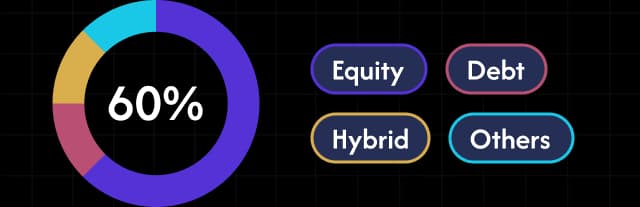
- 80% of the portfolio is comprised of large-cap stocks that are diversified across around 23 industries.
- Some of the top companies include HDFC Bank, ICICI Bank, and Reliance Industries, which are common names found in large-cap portfolios owing to their high market capitalisation.
- Financial services, information technology, and consumer-focused sectors such as FMCG have historically accounted for a significant proportion of total assets, at times exceeding half the portfolio across the top three sectors.
- This sectoral concentration is broadly consistent with the composition of the Nifty 100 index itself, rather than an unusual deviation.
- The residual allocation to mid- and small-cap stocks provides limited scope for the fund managers to exercise independent conviction beyond the largest, most liquid names.
Who Should Invest in Bandhan Large Cap Fund
This fund is generally appropriate for investors seeking equity market participation with comparatively lower volatility than mid-cap or small-cap alternatives.
- Investors with a long-term horizon of ten years or more, planning for retirement or other significant financial goals
- Individuals seeking stability through exposure to established, financially sound companies
- Existing investors in mid-cap or small-cap funds seeking a more stable allocation within their portfolio
- Investors prepared to remain invested through periods of flat or negative short-term performance
- First-time equity investors seeking a comparatively lower-volatility entry point through systematic investment
This fund may be less suitable for investors expecting returns comparable to mid-cap or small-cap categories, or those with an investment horizon of under three years.
Taxation on Bandhan Large Cap Fund
As an equity-oriented mutual fund scheme, taxation follows the standard framework applicable to equity funds in India.
- Units redeemed within one year of investment attract short-term capital gains tax at a flat rate of 20%.
- Units held for more than one year qualify for an exemption on long-term capital gains up to ₹1.25 lakh in a financial year. Gains exceeding this threshold are taxed at 12.5%.
- No indexation benefit is available for equity fund investments under current tax regulations.
- Remaining invested for the long term, consistent with the fund's underlying investment objective, generally results in more favourable tax outcomes.
Final Thoughts
All things considered, Bandhan Large Cap Fund follows a disciplined, mandate-driven approach rather than pursuing aggressive short-term positioning. The improvement in relative performance since the December 2024 change in fund management, combined with a track record extending back to its earlier identity as IDFC Large Cap Fund, supports its consideration as a core equity holding. For investors seeking steady, long-term equity exposure with limited need for active portfolio monitoring, Bandhan Large Cap Fund merits consideration. Connect with experts at MySIPonline for expert guidance on selecting a suitable mutual fundsbased on your financial goals, risk profile, and investment horizon.
FAQ’s
1. What is the minimum SIP amount for Bandhan Large Cap Fund?
The minimum SIP investment in Bandhan Large Cap Fund is ₹100, while the minimum lumpsum investment is ₹1,000. Investors should refer to the scheme documents for applicable conditions.
2. Who manages Bandhan Large Cap Fund?
Bandhan Large Cap Fund is managed by the fund-management team appointed by Bandhan Mutual Fund. The current managers include Manish Gunwani and Prateek Poddar, appointed since December 2024.
https://www.mysiponline.com/mutual-fund/bandhan-large-cap-fund/mso27893. Is lump sum investment allowed in Bandhan Large Cap Fund?
Yes. Bandhan Large Cap Fund accepts lumpsum investments, with the minimum amount currently listed as ₹1,000. The applicable purchase terms should be checked before investing.
4. When was Bandhan Large Cap Fund launched?
Bandhan Large Cap Fund has a long operating history, but the scheme’s name and fund-house ownership have changed over time. Investors reviewing historical performance should account for these changes when comparing past records.
5. Why has the fund's 1-year return been lower than its 3-year and 5-year returns?
Short-term and long-term returns can differ because equity markets move through different phases. Market corrections, sector performance, portfolio positioning, and broader market conditions can all affect returns over different periods.