Amid global market volatility, rising gold prices and ever evolving interest rate trends, investors are looking for the best mutual funds to invest in 2026 often face one common doubt: How do I grow my wealth without putting all my coins in a single basket? And the answer lies in multi asset allocation fund (MAAF). Whether you are a first time SIP investor or a seasoned portfolio builder, 2026 is the suitable year to understand how these funds probably works, which one to stand out and whether they belong in your financial plan. This write up gives you valuable insights regarding top MAAF, taxation rules and more for your investment landscape.
What is a Multi Asset Allocation Fund?
A Multi Asset Allocation Fund refers to the mutual fund which invests your money across multiple asset classes including equity, debt and gold or other commodities in a single portfolio to balance risk and returns. The major advantage of MAAF is its diversification, which helps balance returns and reduce volatility.
As per the AMFI data, the AUM of MAAF has significantly grown from ₹12,636 crore in January 2018 to over ₹1,50,562 crore by September 2025 which is an 11 times increase, highlighting the strong confidence in this category.
SEBI's Mandate: The Debt Pillar Rule Explained
The structure of every MAAF in India is governed by SEBI's landmark Categorisation and Rationalisation of Mutual Fund Schemes Circular issued on 6th October 2017 with the objective to bring uniformity and transparency to the mutual fund industry.
As per the SEBI rule, a MAAF fund must:
- Invests in a minimum of three asset categories.
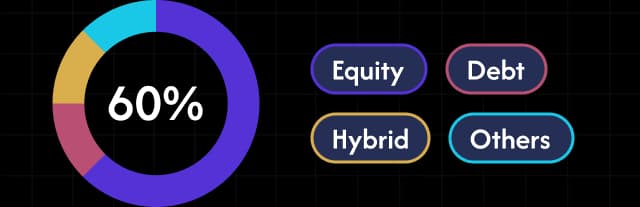
- Maintain a minimum 10 % allocation to each asset at all times.
Besides the fund manager retains flexibility over how to deploy the remaining 70% as per the prevailing economic outlook.
How a Multi-Asset Fund Balances Your Capital?
As of now we have established that MAAF operates on three core foundational pillars and each serving an individual function in your portfolio. Equity as a growth engine, debt as a stability anchor and commodities as an inflation hedge, all of them collectively balance your capital.
- Equity: Growth Engine
According to the SEBI rules, most of the MAAFs maintain equity instruments as the dominant allocation, often 65% or more to capture market upside across large cap,mid cap and sectoral opportunities. The fund manager has the flexibility to rotate across market capitalisation and sectors on the basis of where value lies.
- Debt: Stability Anchor
Debt instruments offer income and capital protection through government securities, treasury bills and short duration paper stabilize the portfolio of investors during equity downturns. Though a minimum 10% debt allocation is mandated by SEBI but most of the funds maintain higher allocations specifically during hiked interest rates or stretched equity valuations.
- Commodities: Inflation Hedge
Gold, silver and other commodities need help to protect against inflation and currency weakness. It often rises when prices go up and balances losses in other assets. Fund managers actively adjust allocations, more often in strong markets and more debt and gold during risky periods. This makes the MAAF more flexible as compared to fixed strategies.
Gold & Silver Mutual Funds in Multi-Asset Funds
The most defining features of a modern MAAF are its exposure to commodities, mainly via gold and silver mutual funds which are later then invested in ETF via Funds of Fund (FoFs)::
- Gold as a Portfolio Shield
Gold has historically served as a store of value during periods of inflation, currency depreciation, and geopolitical uncertainty. In the MAAF framework, gold does not merely add returns, it reduces correlation risk. When equity markets fall sharply, gold tends to hold its value or even appreciate.
- Silver: The Emerging Pillar
Silver has emerged as a secondary commodity in several MAAFs. Some of the funds now allocate a portion of their commodities exposure to a silver mutual fund which later invests in ETF via FoFs, giving dual commodity diversification.
Multi-Asset Funds vs Pure Equity: Key Differences
MAAF vs pure equity differ in risk, returns and diversification, helping investors opt for the right fund based on goal and risk appetite:
| Parameter | Multi-Asset Allocation Fund | Pure Equity Fund | Liquid / Debt Fund |
|---|---|---|---|
| Expected Return (5Y CAGR) | 11% – 14% | 13% – 17% | 6% – 7.5% |
| Max Drawdown (Historical) | –18% to –25% | –35% to –55% | –1% to –3% |
| Volatility (Standard Dev.) | Moderate | High | Low |
| Rebalancing (Asset Classes) | Automatic by the fund manager | Manual by the investor | Not applicable |
| Asset Classes | 3+ (Equity, Debt, Commodities) | 1 (Equity only) | 1 (Debt only) |
| Suitable Horizon | 3+ years | 5–7+ years | 1 day – 1 year |
| SEBI Category | Hybrid – Multi Asset | Equity Schemes | Debt Schemes |
Pro tip: With our SIP calculator, calculate how consistent investing and compounding can help you build wealth.
Top Multi-Asset Funds to Consider in 2026
Multi asset funds are gaining attention as investors look for balanced stability in 2026. Below are some of the best multi asset allocation funds that must be considered this year:
| Scheme Name | Launch Date | AUM (Cr) | 3 Yrs Return (%) | 5 Yrs Return (%) |
|---|---|---|---|---|
| ICICI Pru Multi Asset Fund | 31-10-2002 | 83,547 | 16.61% | 17.18% |
| Nippon India Multi Asset Allocation Fund | 10-08-2020 | 14,738 | 19.58% | 15.42% |
| Quant Multi Asset Allocation Fund | 21-03-2001 | 5,268 | 23.61% | 19.46% |
| SBI Multi Asset Allocation Fund | 21-12-2005 | 17,666 | 16.79% | 13.28% |
| WhiteOak Capital Multi Asset Allocation Fund | 12-05-2023 | 7,118 | 15.45% | — |
Pro tip- Investors can compare the corpus between SIP and step-up SIP by navigating step up SIP calculator in detail.
Who Should Invest in Multi Asset Allocation Funds?
MAAF are not for everyone but for the following investors they are well suited. Below is a quick guide:
1.Ideal For
- For first time investors who want diversification without managing multiple funds across categories via a single SIP
- Moderate risk investors looking for equity like returns.
- Goal based investors with a 3-7 year horizon.
- Retirees or near retirees who want growth but also capital protection.
- Investors holding pure equity mutual fundsare looking to balance their overall portfolio risk.
2.Not Ideal For
- Investors with a very short term horizon
- Those seeking maximum returns and willing to accept full equity level risk.
- Investors already hold a highly diversified portfolio.
Tax Rules for Multi-Asset Funds in 2026
Taxation of MAAFs mainly depends directly on the fund's equity allocation percentage as of each re-balancing date. Here SEBI and Income Tax rules create three distinct tax brackets:
| Parameter | Equity-oriented ≥65% | Specified 35–65% Equity | Debt-oriented <35% |
|---|---|---|---|
| Short-term Gains | 20% (Held ≤12 Months) | Slab Rate (Held ≤2 Years) | Slab Rate — All Holding Periods |
| Long-term Gains | 12.5% LTCG (Held >12 Months) | 12.5% LTCG (Held >2 Years) | No LTCG Benefit |
| LTCG Exemption | ₹1.25 Lakh/Year | ₹1.25 Lakh/Year | No Exemption |
| Indexation | Not Available | Not Available | Not Available |
Conclusion: Should You Invest in 2026?
Summing up! Investment landscape looking for a balance between growth and protection, and opportunity and risk management. MAAF are built precisely for this kind of environment. With SEBI's 10% minimum allocation rule ensuring genuine diversification and a mandatory debt pillar offering stability and silver/ gold mutual funds giving inflation protection it offers a well structured sound, all weather investment vehicle for the Indian retail investor.
Faq’s
-
Can IInvest In Multi Asset Allocation Funds Via Sip?
Yes you can invest in MAAF via SIP allowing disciplined investing, rupee cost averaging and long term wealth creation with exposure to equity, debt and commodities.
-
What Are the Expected Returns of a Multi Asset Allocation Fund?
MAAF majorly offer moderate to higher returns, depending on market conditions, mainly better stability as compared to pure equity because of diversification across equity, debt and gold.
-
What Is the Minimum Investment In a Multi Asset Allocation Fund?
₹500 to ₹1,000 is the minimum investment for SIPs, and around ₹5,000 for a lump sum with the fund house.
-
Is a Multi Asset Allocation Fund Better Than a Balanced Advantage Fund?
Both serve different requirements, MAAF offer broader diversification across all assets, whereas balanced advantage funds dynamically adjust equity and debt, making neither university better but appropriate for different risk profiles.