Table of Contents
The latest announcement of the 8th pay commission salary hike has raised expectations among government employees and pensioners. This will significantly impact nearly 50 lakh government employees and 69 lakh pensioners. Everyone has a question in mind that “How much will my basic pay increase?” The simple answer lies in the 8th pay commission fitment factor, which is the multiplier upgrading the 7th pay commission to the 8th pay commission.
The commission is formed every 10 years to review pay, pension and allowances that cost the government around Rs 1.8 lakh crore. The government issued the terms of reference (ToR) on 3 November 2025, and implementation is expected to begin on 1 January 2026, effectively starting the revival process of salaries and pensions for the decade. The commission will submit its report within 18 months. But will the 8th Pay Commission fulfil the expectations of around 1.15 crore people involved or is there a need for fact-checking? Let us dive deeper for more.
What is the 8th Pay Commission?
The 8th Pay Commission is a panel of various government bodies and economists formed by the central government to review and revise salaries, pensions & allowances of central government employees and pensioners. The commission will submit the report after studying the current state of the economy.
This ensures that the pay level maintains a balance between rising living costs and changing economic conditions. Once the government approves the report, it will become the basis for the determination of salaries and pensions of the employees for the next decade.
Historical Timeline of India’s Pay Commissions
The pay commission has a long history even before independence with the establishment of the first pay commission in January 1946. The panel was set up to revise and recommend the salary structure of government employees. Let us quickly understand how the payment structure has evolved:
| Commission | Period | Min. Basic Pay (in Rs.) | Major Milestone |
|---|---|---|---|
| 1st CPC | 1946–1947 | 55 | Established the concept of a “living wage.” |
| 2nd CPC | 1957–1959 | 80 | First to merge 50% DA with basic pay. |
| 3rd CPC | 1970–1973 | 185 | Focused on salary parity with the private sector. |
| 4th CPC | 1983–1986 | 750 | Introduced tenure-based promotions. |
| 5th CPC | 1994–1997 | 2,550 | Reduced the number of pay scales from 51 to 34. |
| 6th CPC | 2006–2008 | 7,000 | Introduced Pay Bands & Grade Pay. |
| 7th CPC | 2014–2016 | 18,000 | Replaced Grade Pay with the Pay Matrix System. |
| 8th CPC | 2025–2026 | 21,600+ | Integration with the Unified Pension Scheme (UPS). |
Over the decades, the pay commission used various multipliers or individual pay scale adjustments. Still, the term “Fitment Factor” introduced in the 7th pay commission was first formally used and accepted as a standard concept. This established a uniform multiplication factor (set at 2.57) applied for all pay levels to upgrade the old structure to the new pay matrix.
Also Read - Beat Inflation to Secure Retirement with Mutual Funds
Understanding the 8th Pay Commission Fitment Factor
The fitment factor is the central concept in any pay commission report, including the 8th pay commission. Understanding it is crucial to know what your actual pay hike might look like once the new recommendations are applied.
What is a Fitment Factor?
Fitment factor is basically a multiplier used to calculate the current basic pay. In simple words, it determined how much your upgraded salary would be after the approval of the report. The number also affects the pensions and allowances, which makes it a key factor of the 8th pay commission.
Why Fitment Factor Matters?
The fitment factor is an essential element of any pay commission report, as it directly affects millions of employees across government sectors. Here is why it matters a lot in the 8th Pay Commission:
- The fitment factor is directly applied to your current salary. This ensures that the upgrade from the 7thCPC to the 8th CPC is uniform at every level.
- The basic pay is the base of all other benefits, which means an increase in basic pay will increase your House Rent Allowance (HRA) and Travel Allowance (TA).
- It determines the pensions of the retired employees.
How Fitment Factor is Determined?
The fitment factor is not just a random guess but it is a result of financial research and economic analysis. In general, it ensures a uniform increase in salary structure at all levels while keeping in mind the inflation rate, market standards, and government financial capacity. The fitment factor is not calculated for each individual but decided by the commission after thorough analysis of several factors:
- It should ensure that the overall increase is sustainable for the government.
- The balance between pay hike and rising prices should be maintained.
- The uniformity is maintained across ranks and between different services.
- Historical Fitment factors are taken into consideration for continuity.
Also Read - Why Should I Bother About Inflation While Planning investments?
Start Your SIP TodayLet your money work for you with the best SIP plans.

8th Pay Commission Salary Pay Matrix
The pay matrix is the most user-friendly concept of the pay commission in the 7th CPC. It eliminates the old, confusing “Pay Bands and Grade Pay” system. It is a structured table that determines the salary of government employees based on their grade, level and years of service. The new pay matrix is introduced in the 8th CPC, which will define all the 8th pay commission salary slabs based on historical trends and the likely fitment factor. While the exact figure will be announced only after the 8th CPC report is approved but estimated figures have been drafted between the range of 1.92 and 2.28.
Below is an illustrative presentation of what it might look like:
| Level | Current Basic (7th CPC) | Expected 8th CPC Basic (1.92x) | Expected 8th CPC Basic (2.28x) |
|---|---|---|---|
| Level 1 | 18,000 | 34,560 | 41,040 |
| Level 2 | 19,900 | 38,208 | 45,372 |
| Level 3 | 21,700 | 41,664 | 49,476 |
| Level 4 | 25,500 | 48,960 | 58,140 |
| Level 5 | 29,200 | 56,064 | 66,576 |
In short, this matrix clearly expresses fairness & transparency for all levels of government employees under the 8th pay commission salary hike.
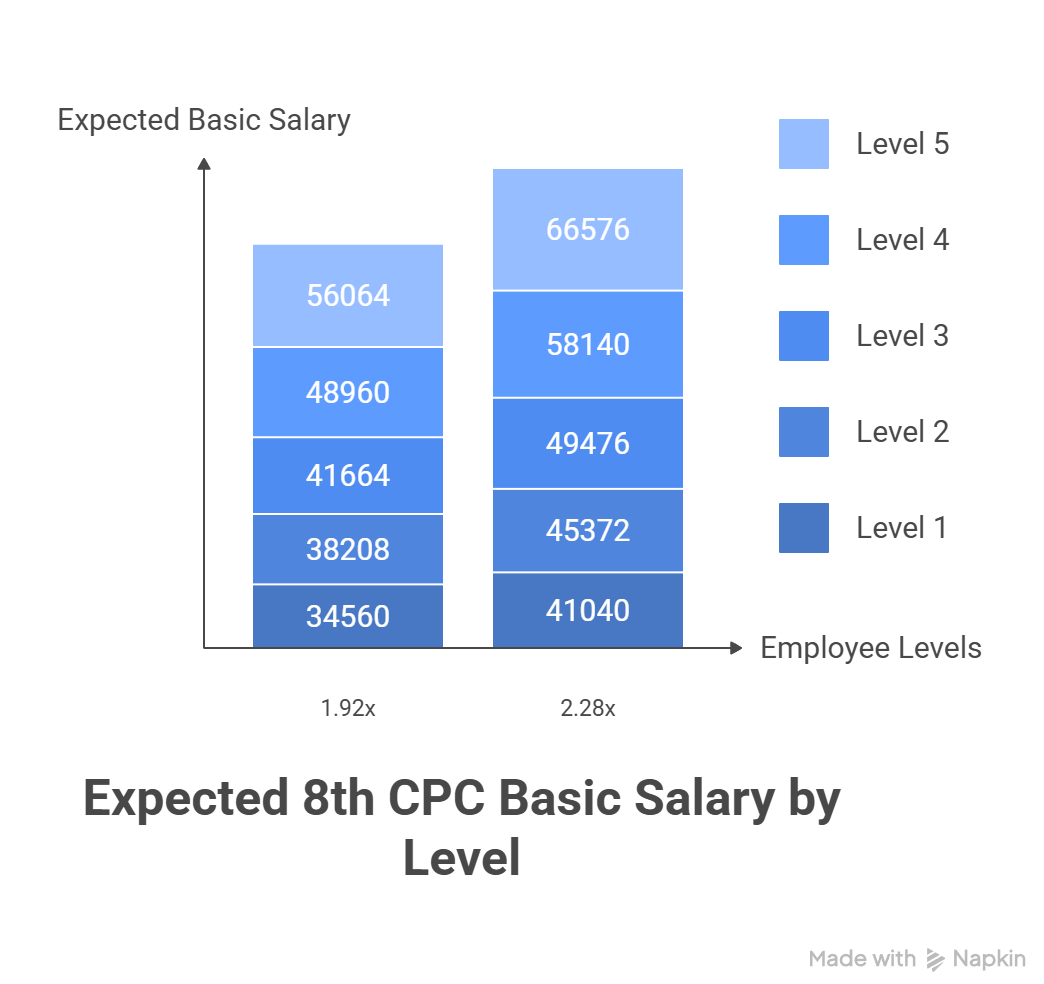
This chart compares expected basic salaries across employee levels under the 8th CPC. It highlights how basic pay is expected to increase from level 1 to level 5.
Key Factors Affecting 8th CPC
Setting the new fitment factor is not just about deciding a number. The 8th Pay Commission, led by Justice Ranjana Prakash Desai, must take into consideration the expectations of the employees and the financial health of the government. Understanding these key factors helps employees to forecast better about the expected changes:
- The overall GDP growth plays a vital role in allowing the government to approve larger pay hikes.
- The 8thCPC also considers the rising prices or inflation rate to ensure that salary increments balances with real value over time.
- The fitment factor has also beentaken into consideration, as a slight increase in fitment factor may lead to increased pay budget.
- Previous pay commission trends also help provide benchmarks for salary hikes and fitment factors, helping the 8thCPC maintain consistency and fairness.
- Changes in allowances such as HRA, TA, and DA affect the overall in-hand salary.
- Promotions, level upgrades and service experience also count as key factors in deciding the fitment factor.


Smart Investments, Bigger Returns

Conclusion
The 8th Pay Commission is all set to bring considerable hikes in salaries and pensions. It certainly addresses the rising cost of living while attempting to balance the government’s economic status. While the process is time consuming but the final result is expected to benefit a large number of employees & retirees.
Related Blogs:
- Top 10 Angel Investors in India: Fueling Startup Success in 2025
- Term Insurance vs Life Insurance: Which is Best for You?
Frequently Asked Questions
-
What is the 8th Pay Commission?
The 8th Pay Commission is a government panel that reviews and revises the salaries, pensions and allowances of central government employees & pensioners. It is usually set up once every 10 years. -
Who will benefit from the 8th Pay Commission?
Nearly 50 lakh central government employees and around 69 lakh pensioners are expected to benefit from the 8th Pay Commission. -
What is the fitment factor?
The fitment factor is a number used to calculate the revised basic pay. It multiplies the current basic salary to arrive at the new pay. -
Will pensioners also get benefits under the 8th pay commission?
Yes, pensioners will also benefit. Since pensions are linked to basic pay, any increase in basic salary will lead to higher pension amounts. -
Will allowances like HRA and DA increase?
Allowances are usually linked to basic pay. If basic pay increases, allowances such as HRA and DA are also likely to increase. -
How long will the commission take to submit its report?
The commission is expected to submit its report within 18 months of its formation. -
Where can employees get official updates?
Employees should rely on official government notifications & trusted news sources for accurate updates on the 8th Pay Commission.